


Carbon nanotube technology: An efficient platform for virus enrichment and virus strain detection
The global COVID-19 pandemic had devastating impact on individual livelihoods, local communities, and the global economy. Accurate, real-time, and widespread testing is needed in order to track the disease, prevent further infections, and gain basic fundamental understanding of the disease, such as the number of infections, infection rate, etc. This talk will discuss the design and fabrication of disposable cartridges using a label-free virus enrichment platform consisting of microarrays of aligned carbon nanotubes (CNTs) in conjunction with gold metal nanoparticles. These trapped viruses are detected and identified using Raman spectroscopy in conjunction with Machine Learning models. More importantly, after viral capture, these viruses remain viable permitting subsequent in-depth characterizations by various conventional methods. This technology successfully enriched rhinovirus, influenza virus, coronavirus and parainfluenza viruses, and maintained the stoichiometric viral proportions when the samples contained more than one type of virus, thus emulating coinfection. Viral capture and detection took only a few minutes with a 70-fold enrichment enhancement; detection could be achieved with as little as 102 EID50/mL, with a virus specificity > 95%. This enrichment method coupled to Raman virus identification constitutes an innovative system that could be used to quickly track and monitor viral outbreaks in real-time.
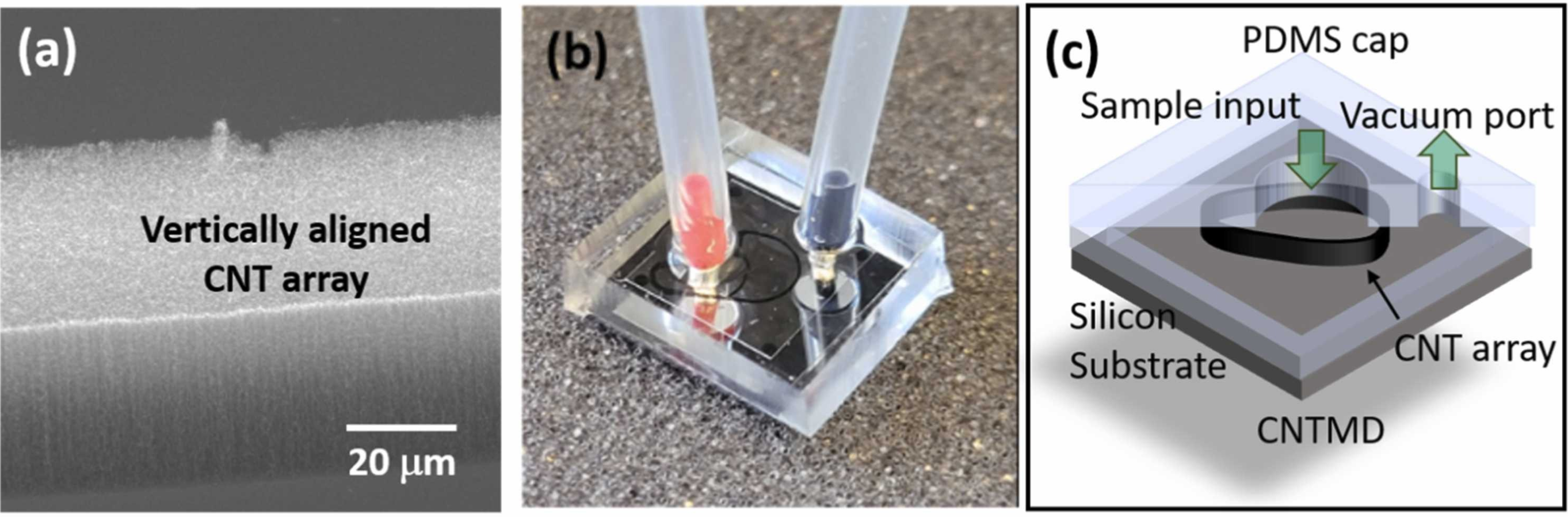
Figure 1. (a) SEM micrograph of the vertically aligned carbon nanotubes. (b) A picture of a CNT microfluidic device. (c) Schematic depiction of the cross section of a CNT device.
Mauricio Terrones, obtained his B.Sc. degree in Engineering Physics with first class honors at Universidad Iberoamericana, and was distinguished as the Best Student of Mexico in Engineering Physics in 1992. In 1994 he started his doctorate degree with Sir Prof. Harold W. Kroto (Nobel Laureate, FRS), and received his D.Phil. degree from University of Sussex in 1998. He has co-authored more than 650 publications in international journals and counts with more than 96,000 citations to his work (His H index is 130; Google Scholar H=150). He has published in Nature, Science, Phys. Rev. Lett., Nano Lett., Nature Nanotechnology, Nature Materials, Nature Communications, Nature Chemistry, ACS Nano, PNAS, Science Advances, etc. Some of his accomplishments include: 1) Fellow of APS, AAAS, TWAS and RSC; 2) Highly Cited Researcher (WoS; 2017-present); 3) The Jubilee Professorship at Chalmers University of Technology (Sweden; 2016), 4) Visiting Fellow, Trinity College, University of Cambridge (UK; 2012), 5) “The Somiya Award for International Collaboration” (IUMRS; 2009), 6) “The Japan Carbon Award for Innovative Research” (Japan Carbon Society; 2008), 7) “TWAS Prize in Engineering Science,” Academy of Sciences of the Developing World, 8) UNESCO-Javed Husain Prize for Young Scientists and Albert Einstein Medal (France, 2001), 9) Alexander von Humboldt Fellowship, Max-Planck-Institut für Metallforschung (Stuttgart, Germany), 10) The Best Student of Mexico Award (Mexico, 1992).
Mauricio Terrones is Evan Pugh University Professor and the George A. and Margaret M. Downsbrough Department Head (Department of Physics, Penn State). He is also Professor of Physics, Chemistry and Materials Science & Engineering at Penn State. He is also the Founder Director of the Center for 2-Dimensional and Layered Materials at Penn State, and the NSF-IUCRC Center for Atomically Thin Multifunctional Coatings (ATOMIC). He is also the Editor-in-Chief of the journal Carbon (IF=11.6).
Research: Mauricio Terrones works on low dimensional materials that mainly involve 1- and 2-Dimensions, ranging from carbon nanotubes and graphene nanoribbons to graphene, boron nitride and chalcogenide monolayers (e.g. WS2, MoS2, NbS2 , etc.). His group concentrates on challenging synthesis of novel nanoscale materials (1D and 2D) with unprecedented physico-chemical properties. Within his group and with close collaborators, he performs theoretical first-principles calculations that predict electronic, chemical, optical and magnetic properties. He also focuses on performing state of-the-art characterization of the produced materials using electronic transport, photo-transport, Raman spectroscopy, aberration corrected transmission electron microscopy, photoluminescence, electron energy loss spectroscopy, etc.
PennState University – Department of Materials Science and Engineering (MatSE)
Web: www.psu.edu
There’s a reason Penn State consistently ranks among the top universities in the world. Across multiple campuses and an online World Campus, our 90,000 students and 20,000 faculty and staff know the real measure of success goes beyond the classroom—it’s the positive impact made across the world.
MatSE is shaping the diverse leaders of tomorrow while driving sustainable discoveries that will transform our world. Through educational innovation, pioneering research, entrepreneurial spirit, and active community engagement, we are enabling the technologies that will meet the needs of the 21st century.
For more than 115 years MatSE has been making groundbreaking contributions to materials science and engineering, we remain committed to pushing boundaries, fostering education, and advancing the materials that define the future.